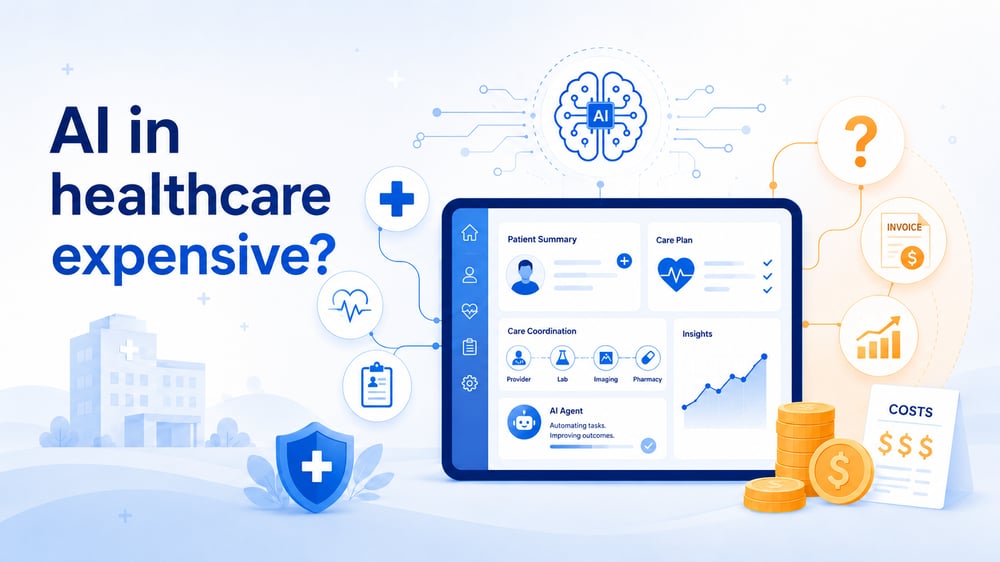
By Jay Chowdappa, MD, co-founder and CEO, Zynix AI · Updated October 1, 2026
Key takeaways
AI makes healthcare more expensive when it is pointed at fee-for-service work such as documentation capture, coding intensity and billing throughput, because those raise reimbursement without lowering total cost of care. Inside accountable care, the same technology can lower avoidable cost if it completes follow-ups, wellness visits, gap closure and high-risk outreach sooner.
- AI does not reduce cost on its own; it optimizes whatever workflow it is pointed at, so the incentive model decides the outcome.
- PwC named AI-enabled documentation and coding tools among the drivers of rising 2027 medical cost trend in the group and individual markets.
- ACO cost leaks where known work goes undone, such as late discharge follow-up, unscheduled wellness visits, open gaps and high-risk patients nobody reached.
- Measure AI by completed cost-relevant actions and utilization trends, not by time saved or call volume.
- Keep clinical judgment with clinicians and give agents the repeatable outreach, reminder, scheduling and routing work.
There is a growing concern in healthcare that AI may make care more expensive instead of more affordable.
That concern is valid.
AI is often marketed as a cost-reduction technology, but healthcare economics are not that simple. In a fee-for-service environment, technology that helps providers document more completely, code more accurately, generate more services, or increase throughput can also increase total spend. That does not mean the technology is bad. It means the incentive model matters.
AI does not automatically reduce cost. It optimizes the work it is pointed at. Point AI at billing, documentation, scheduling, or coding, and it can increase reimbursement, capture, visit volume, or acuity capture. Each can be a legitimate goal. None necessarily lowers total cost of care.
That is why value-based care needs a different AI conversation. The question should not be "Does AI save money?" The question should be: which workflows is AI optimizing, and under which economic model?
Will AI make healthcare more expensive?
Yes, in certain contexts. When pointed at fee-for-service workflows: AI can make healthcare more expensive if it is mainly used to increase documentation capture, coding accuracy, billing throughput, service volume, or reimbursement activity.
Not necessarily. When pointed at accountable care execution: AI does not have to make healthcare more expensive if it is used inside accountable care to complete workflows that prevent avoidable utilization and close gaps earlier.
The difference is the workflow and the incentive model, not the technology itself.
Why the cost concern is real
Recent reporting has made this issue more visible. Axios reported in June 2026 that PwC expected medical costs to keep rising in the employer and individual markets in 2027, with AI-enabled software and scribes that more thoroughly document delivered care cited as one of the drivers.
That concern fits the structure of healthcare economics. In fee-for-service, more capacity can mean more billable activity. Better documentation can mean higher reimbursement. More coding detail can mean higher acuity capture. More throughput can mean more visits.
These outcomes may help individual provider organizations financially. But they do not automatically reduce total spend. This is why the AI ROI conversation in healthcare is often too broad. "AI saves time" is not the same as "AI lowers cost." "AI improves documentation" is not the same as "AI reduces avoidable utilization."
Why ACOs have a different opportunity
An accountable care organization is rewarded for improving quality while controlling cost. That makes the AI strategy fundamentally different.
The highest-value AI use cases for ACOs are the ones that complete the right work earlier and more consistently. For ACOs, avoidable cost often grows in the gap between knowing and acting.
Where avoidable cost is created in ACO operations
Avoidable cost often grows in the gap between knowing and acting. These are the four workflow failures that drive that gap.
Follow-up delayed after discharge. The discharge feed arrives. The patient is flagged. But the follow-up call does not happen within the required window. Every day of delay increases readmission risk and puts TCM billing at risk. Impact: Readmission risk, missed TCM revenue.
Annual wellness visit never scheduled. The patient is overdue. The care team knows. But outreach never happens because coordinators are already managing active cases. The visit window closes. The quality gap stays open. Impact: Quality score drag, lost AWV revenue.
Care gap not closed at point of care. A gap is identified during a visit. It is not addressed in the moment. A task is created. The task goes unresolved. The performance year ends with an open gap that was already seen. Impact: HCC score impact, shared savings loss.
High-risk patient not reached. The risk model surfaces a rising-risk patient. The care team is already at capacity. No outreach happens. The patient deteriorates to a point where intervention costs significantly more. Impact: ED visit, avoidable hospitalization.
None of these failures are caused by a lack of intelligence. They are caused by a lack of execution capacity. That is where AI can reduce cost in value-based care -- not by producing another risk list, but by helping the organization complete the workflows that prevent avoidable utilization.
What healthcare AI ROI should measure
The distinction matters because healthcare AI ROI is often measured too narrowly. Time saved, documentation speed, administrative productivity, and call volume are useful metrics, but they are not enough for accountable care. ACOs should measure whether AI improves completion of cost-relevant actions.
Outcomes that map to value-based care economics
- More post-discharge follow-ups completed within the required window
- More annual wellness visits scheduled and completed
- More care gaps closed before the performance year ends
- More high-risk patients reached before escalation
- Fewer avoidable emergency department visits and readmissions
- Higher care manager capacity without proportional headcount growth
- Lower cost per completed outreach or follow-up action
These metrics are closer to the economics of value-based care because they measure work completed, not just time saved.
A five-step framework for ACO leaders
The risk for healthcare leaders is adopting AI because it is trending, then applying it to workflows that do not change financial performance. A tool that summarizes charts may be useful, but if the organization still cannot reach patients, schedule visits, close gaps, or escalate issues, the core operating problem remains.
Here is a more disciplined five-step framework for ACO leaders.
1. Identify the cost drivers
For ACOs, these typically include avoidable hospitalizations, emergency department visits, unmanaged chronic disease, missed preventive care, medication issues after discharge, and late escalation of clinical risk.
2. Identify the execution gaps
What work should have happened earlier? Was the patient contacted? Was the visit scheduled? Was the gap closed? Was the clinical exception escalated?
3. Identify where AI can safely increase completion
Not every step should be automated. But many steps can be supported under guardrails: outreach, reminders, eligibility checks, task routing, documentation, scheduling coordination, status updates, and escalation triggers.
4. Measure outcomes at the workflow level
ACO leaders should know how many patients were reached, how many follow-ups were completed, how many gaps were closed, how many exceptions were escalated, and what changed in utilization over time.
5. Keep humans in the right role
The purpose of AI in accountable care is not to remove clinical judgment. It is to protect clinical judgment from repetitive work.
The digital workforce answer
This is where the phrase digital workforce becomes useful.
A digital workforce is not a chatbot. It is a set of governed AI workers designed to complete defined operational workflows. In an ACO, that may mean a voice agent for discharged patients, a workflow agent for unresolved cases, and a care gap agent for next-best outreach. Each agent has a role, boundaries, and measurable output.
The case depends on where those agents are deployed. Point AI at maximizing billing in a fee-for-service model, and cost concerns grow. Point it at closing execution gaps in accountable care, and the conversation changes.
In value-based care, the best AI use cases help organizations do the right thing sooner.
- Reach the patient sooner. Before the window for effective intervention closes.
- Close the gap sooner. Before it affects quality scores or shared savings.
- Schedule the visit before it is overdue. Proactive outreach before the gap becomes avoidable utilization.
- Escalate the risk while there is still time to act. Not after the costly event has already occurred.
That is what keeps the avoidable event from becoming the expensive one. That is the answer to whether AI will make healthcare more expensive.
It depends on whether AI is used to optimize revenue activity or accountable care execution.
At Zynix AI, we believe healthcare does not need more AI that only tells teams what to do. It needs AI that helps complete the work that lowers risk, improves quality, and reduces avoidable cost.
Adoption rates make a nice slide. They will not settle the ROI argument. The number that actually matters is how much work got done.
Frequently asked questions
Do AI scribes and coding tools raise healthcare costs?
They can raise total spending under fee-for-service payment. Tools that document more completely and code with more specificity tend to raise reimbursable severity and paid amounts per claim, which PwC listed among the inflators of 2027 medical cost trend. That can be accurate, legitimate payment, but it does not lower total cost of care. Whether it helps depends on the incentive model the tool works under.
How can AI lower costs for an ACO?
By completing the work that prevents avoidable utilization: reaching discharged patients inside the follow-up window, scheduling overdue wellness visits, closing care gaps before the performance year ends and contacting rising-risk patients before they escalate. In the Shared Savings Program, an ACO may share in savings when it both delivers high-quality care and spends wisely, so TCM, wellness visit and care gap programs are where this work shows up.
How should an ACO measure the ROI of AI?
Measure completed work, not time saved. Track follow-ups completed within the required window, wellness visits scheduled and completed, gaps closed before year end, high-risk patients reached, exceptions escalated and cost per completed outreach action. Then compare avoidable emergency department visits and readmissions against your own baseline over the performance year. Call volume and documentation speed are useful, but they do not show whether cost-relevant work got done.
What is a digital workforce in healthcare?
A set of governed AI agents, each assigned a defined operational workflow such as post-discharge calls, follow-up on unresolved cases or care gap outreach. Each one works within the rules and hours the care team sets, documents every attempt and hands clinical questions to staff. Unlike a chatbot, it starts work from events in the data instead of waiting for a patient to ask. See how agents work with your care team.
Related reading
- How ACOs Actually Make Money: Shared Savings Mechanics and Where AI Moves the Needle
- Post-Discharge Readmission Reduction: How AI Agents Help ACOs Stop Losing Shared Savings
- How To Scale ACO Operations With the Care Team You Already Have
Source notes
PwC: Behind the numbers 2027. https://www.pwc.com/us/en/industries/health-industries/library/behind-the-numbers.html
CMS: Medicare Shared Savings Program. https://www.cms.gov/medicare/payment/shared-savings-program
About the author
Jay Chowdappa, MD is co-founder and CEO of Zynix AI. He is a physician, and ACOs led by him generated $300M+ in shared savings before he started Zynix AI to help care teams follow through on what their data already shows.
Ready to close the execution gap?
See how Zynix AI helps ACOs turn population health analytics into completed care actions at scale.
Book a 30-min walkthrough →