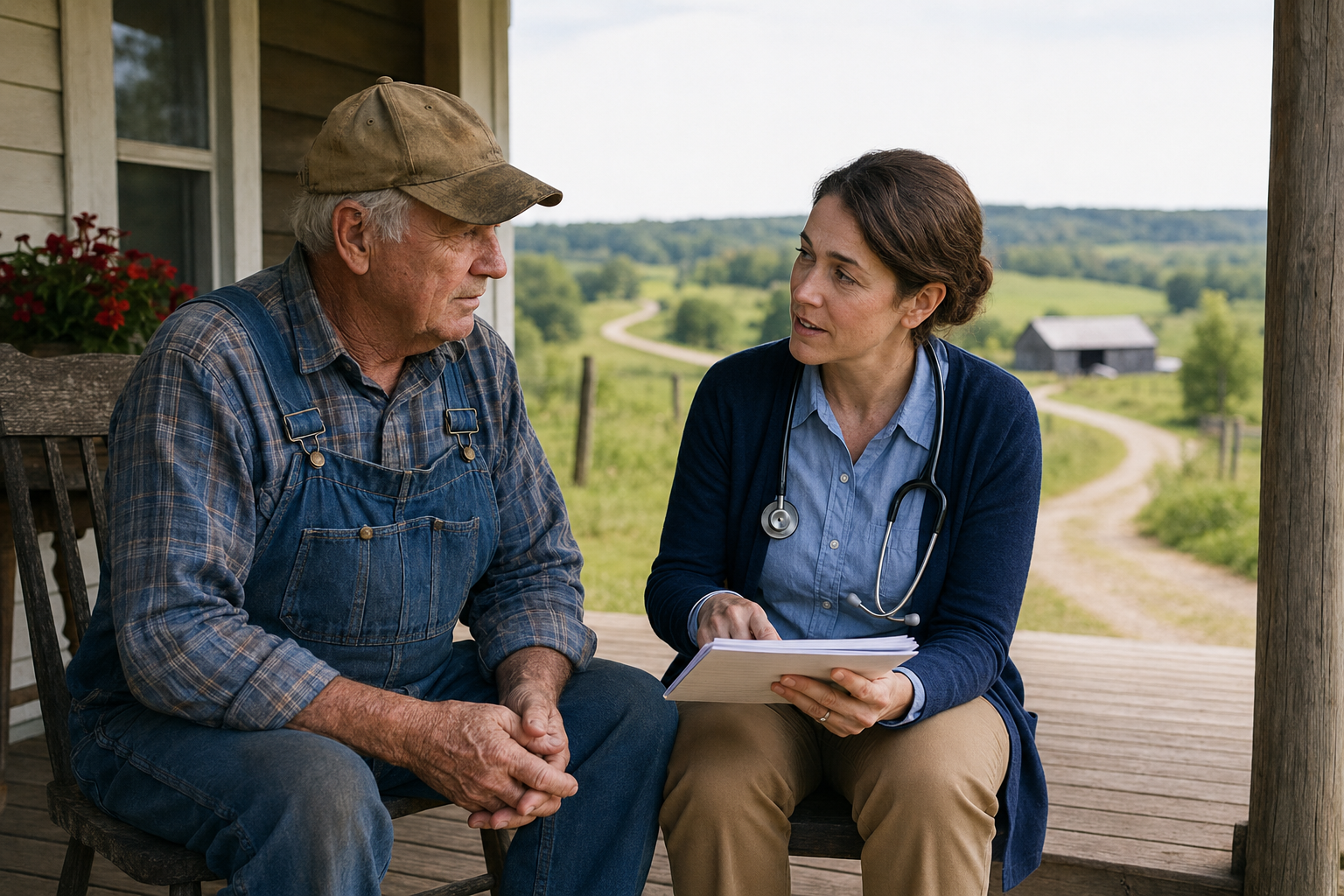
The Rural Health Transformation Program should not be treated as another funding headline but rather as an operating test.
Reuters reported that the program is a 50 billion rural health initiative, with 10 billion available annually from fiscal years 2026 through 2030. States are expected to receive major funding to improve rural healthcare access and service quality. The opportunity is significant. The risk is that funding becomes fragmented technology spend without changing day-to-day patient care.
Rural health transformation will not be measured by how many tools are purchased. It will be measured by whether rural providers can reach more patients, complete more preventive care, follow up faster after acute events, route after-hours needs, and support stretched human teams across distance, workforce shortages, and fragmented systems.
For rural ACOs, FQHCs, Rural Health Clinics, independent practices, and state-level provider networks, the central question is not "What technology should we buy?", but rather "How do we turn funding into durable care capacity?"
Rural Transformation Is a Capacity Problem First
Rural healthcare has many structural constraints. Patients may live far from the nearest practice or hospital. Transportation can be unreliable. Broadband access may vary. Provider supply is limited. Small practices often carry the burden of high patient complexity with fewer operational resources. Rural hospitals and clinics may depend heavily on Medicare and Medicaid reimbursement while managing older, sicker, and more geographically dispersed populations.
Reuters reported in March 2026 that rural areas cover nearly 90% of U.S. land and include about 60 million people, while rural residents are older, have worse health outcomes, and have less access to healthcare services than urban residents. The same report noted that more than 40% of rural hospitals operate at a loss.
That context matters because transformation cannot depend only on more buildings, more reports, or more standalone pilots. Rural networks need a practical way to extend the reach of existing care teams. That means building capacity around the repeatable work of care: outreach, scheduling, reminders, visit preparation, follow-up, documentation, routing, and escalation.
What RHTP Funding Should Actually Enable
RHTP funding should help rural networks build reusable operating capability, not isolated projects.
| Funding Direction | Better Care-Capacity Question |
|---|---|
| Technology investment | Will this help teams reach and support more patients? |
| Workforce support | Will this reduce avoidable manual burden on scarce staff? |
| Access improvement | Will patients get routed to the right next step faster? |
| Quality improvement | Will care gaps and preventive needs be acted on consistently? |
| Rural infrastructure | Will workflows work across practices, sites, and patient geographies? |
| Reporting | Will leaders know whether follow-through actually happened? |
The goal is not to create another layer of administration. The goal is to help local care teams operate with more reach, more consistency, and better continuity. For risk-bearing networks, this also supports shared savings readiness. Better patient connection, stronger preventive care, faster follow-up, and improved care coordination all contribute to the operating foundation ACOs need.
The Rural Care Capacity Stack
Rural networks should think in terms of a care capacity stack: the practical capabilities required to support patients across the journey.
Patient Identification
The network needs a reliable view of patients who are due for AWVs, overdue for follow-up, recently discharged, high-risk, missing screenings, or disconnected from care. Without a shared patient list, the network cannot prioritize.
Preventive Outreach
Annual Wellness Visits, screenings, vaccines, and preventive check-ins are especially important in rural communities where patients may delay care until symptoms worsen. Preventive outreach should be persistent, patient-friendly, and connected to scheduling.
Scheduling Support
Access is not only whether an appointment exists. It is whether the patient can get connected to the right visit at the right time. Rural scheduling workflows must account for transportation, practice availability, distance, caregiver schedules, and communication preferences.
Post-Discharge Follow-Up
After a hospitalization, rural patients may face higher barriers to follow-up: distance, medication confusion, lack of caregiver support, and limited appointment availability. A strong rural model should identify discharges quickly, reach patients, document concerns, support scheduling, and escalate clinical or social barriers.
After-Hours Intake and Routing
Patient needs do not follow practice hours. After-hours calls can reveal medication concerns, symptom changes, caregiver confusion, transportation issues, and post-discharge uncertainty. Rural networks need structured intake, documentation, routing, and next-day follow-up, not just message capture.
Care Gap Follow-Through
Care gaps do not close because they are reported. They close when patients are contacted, visits are scheduled, screenings are completed, results are reviewed, and follow-up is documented.
Human Escalation Pathways
Rural care depends heavily on trust and local relationships. Physicians, nurses, care managers, community health workers, and practice staff should own clinical judgment, complex conversations, care-plan decisions, and relationship continuity. The operating model should make it easier for them to focus on those moments.
Where AI Digital Workforce Makes Sense
AI digital workers should not be positioned as the face of rural care, but as the capacity layer around local care teams. The right use cases are repeatable, measurable, rules-based, and tied to human escalation: AWV outreach and reminders, patient education before preventive visits, no-show recovery, post-discharge check-ins, after-hours intake and routing, care gap follow-up, scheduling support, documentation of outreach attempts, next-day task creation, and escalation of clinical, access, or social barriers.
This is the core advantage: digital workers can scale repetitive work without requiring rural networks to add staff linearly for every new workflow, practice, patient segment, or contract. The human team still owns the work that requires judgment. The digital workforce keeps the workflow moving.
That is the practical model rural networks need: human-led care, supported by digital workers that extend reach across geography, time, and operational complexity.
How Rural Networks Can Build the Model
RHTP planning should move from broad transformation language to specific operating design.
| Step | Operating Action |
|---|---|
| 1. Choose priority workflows | Start with AWV, post-discharge follow-up, after-hours intake, care gaps, or chronic care outreach |
| 2. Define the patient population | Identify which patients are eligible, overdue, high-risk, recently discharged, or disconnected |
| 3. Map current failure points | Locate where outreach, scheduling, documentation, or follow-up breaks down |
| 4. Separate repeatable work from judgment work | Let digital workers support repeatable steps and route exceptions to humans |
| 5. Standardize across sites | Create consistent workflows while respecting local practice relationships |
| 6. Track completion | Measure whether patients were reached, scheduled, seen, followed up with, and escalated when needed |
| 7. Review network performance | Use results to refine staffing, workflows, practice support, and patient engagement strategy |
This keeps transformation grounded in care delivery rather than procurement.
What Rural Networks Should Avoid
RHTP creates a major opportunity, but poor implementation can dilute its value. Avoid these traps:
| Trap | Why It Fails |
|---|---|
| Buying disconnected tools | Creates more systems without more follow-through |
| Focusing only on reporting | Shows the problem without increasing care capacity |
| Treating rural care as one workflow | Rural needs vary by geography, staffing, access, and patient mix |
| Ignoring practice variation | Workflows fail if they do not fit local practice operations |
| Overloading human teams | Transformation fails if every improvement creates more manual work |
| Running pilots without ownership | Results disappear if no team owns next-step execution |
The better approach is to start with workflows that directly improve patient connection and ACO performance.
What Rural Networks Should Measure
A rural care-capacity model should be measured by patient-level follow-through.
| Category | Metrics |
|---|---|
| Reach | Patients contacted, response rate, unreachable patients, preferred channel |
| Prevention | AWVs scheduled, AWVs completed, screenings initiated, vaccines recommended |
| Follow-Up | Discharges identified, follow-ups completed, unresolved issues routed |
| Access | After-hours calls captured, issues categorized, next-day tasks created |
| Care Gaps | Gaps surfaced, gaps acted on, gaps closed |
| Human Escalation | Clinical concerns routed, social barriers escalated, care manager tasks completed |
| Network Performance | Practice participation, workflow completion, patient continuity, shared savings contribution |
The most important question is not whether a state or network funded a transformation project. The question is whether more patients received timely, coordinated, human-led care.
Why RHTP and ACO Strategy Should Connect
RHTP should not sit separate from value-based care strategy. CMS's LEAD model, which follows ACO REACH after 2026, also points toward broader participation from small, rural, independent providers and Community Health Centers, with emphasis on prevention, regular check-ins, care coordination, and care between visits. That overlap matters.
Rural transformation, ACO readiness, preventive care, patient engagement, and shared savings all depend on the same operating muscle: the ability to keep patients connected and move care actions forward consistently.
A rural network that builds AWV capacity is also building ACO capacity. A rural network that improves post-discharge follow-up is also building shared savings capacity. A rural network that structures after-hours routing is also building continuity of care. A rural network that closes gaps consistently is also building quality performance. The work is connected.
Turning Funding Into Care Capacity
The strongest rural health strategies will not be the ones with the biggest technology narrative. They will be the ones that make daily care delivery more reliable. Can the network reach the patient? Can the patient understand the next step? Can the visit get scheduled? Can the follow-up get completed? Can the barrier get routed to a human team? Can the network prove that the loop closed?
That is the practical test of rural transformation.
At Zynix AI, we believe rural healthcare needs scalable support around the human care team. Digital workers can handle repeatable outreach, routing, documentation, and follow-through so local providers can stay focused on clinical judgment, relationships, and patient trust.
RHTP gives rural networks a rare opportunity. The challenge is to make sure funding becomes care capacity, not fragmented spend.
If your rural network, ACO, or provider group is planning around RHTP, Zynix AI can help identify the care workflows where scalable digital workforce capacity can improve patient connection, follow-through, and shared savings readiness.
Source Notes
Reuters: US allots at least $147 million per state for rural health in 2026. https://www.reuters.com/business/healthcare-pharmaceuticals/us-allots-least-147-million-per-state-rural-health-2026-2025-12-29/
Reuters: The fragile economies at the heart of rural hospitals. https://www.reuters.com/world/us/fragile-economies-heart-rural-hospitals-2026-03-19/
CMS: LEAD Model. https://www.cms.gov/priorities/innovation/innovation-models/lead
CMS: Medicare Shared Savings Program. https://www.cms.gov/medicare/payment/shared-savings-program
Ready to close the execution gap?
See how Zynix AI helps ACOs turn population health analytics into completed care actions at scale.
Book a 30-min walkthrough →