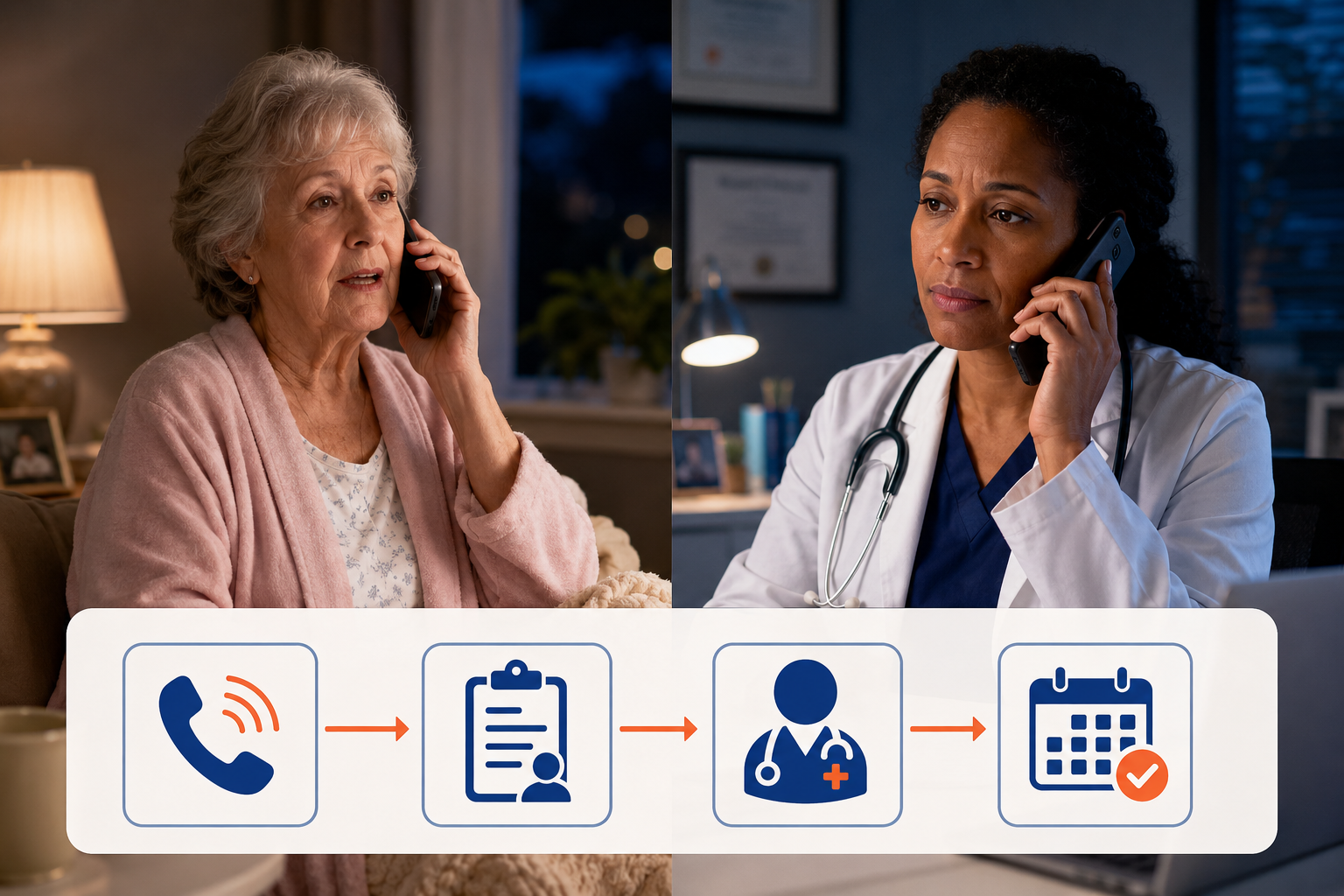
For ACOs, value-based care does not stop when the practice closes. A patient may call after hours because symptoms changed, discharge instructions are unclear, medication questions came up, transportation fell through, a caregiver is worried, or the patient does not know whether to wait, call the doctor, or go to the emergency department.
Those moments are not just call-center moments. They are care-continuity moments. In traditional operations, after-hours calls are often treated as message-taking, answering service coverage, or basic triage. In accountable care, that is not enough.
An ACO is accountable for quality, patient experience, avoidable utilization, and better coordination across the care journey. CMS describes Medicare Shared Savings Program ACOs as groups of doctors, hospitals, and other providers who collaborate to deliver coordinated, high-quality care to people with Medicare, focusing on the right care at the right time while avoiding unnecessary services and medical errors.
If that is the operating standard, after-hours access cannot remain disconnected from the rest of the care model. The question is not simply, "Who answers the phone after 5 pm?" The better question is: "Can the ACO capture the need, understand the risk, route correctly, document the interaction, and make sure the right human team follows up?"
Why After-Hours Calls Matter in Accountable Care
Most ACO workflows are designed around normal business hours. Care managers work during the day. Practice staff schedule during the day. Population health reports are reviewed during the day. Outreach campaigns run during the day. Patients do not operate that way.
Their symptoms, questions, anxieties, and access barriers often show up outside office hours. This is especially true for older adults, recently discharged patients, people with multiple chronic conditions, caregivers managing complex instructions, and patients who do not have easy access to transportation or digital portals.
ACO REACH highlights the same broader direction: helping patients navigate the health system, manage conditions, access enhanced benefits such as telehealth visits and home care after hospitalization, and receive high-quality coordinated care. That direction makes after-hours access strategically important.
After-hours calls can influence:
| Area | Why It Matters |
|---|---|
| Patient trust | The patient feels supported beyond office hours |
| Navigation | The patient receives guidance on the right next step |
| Escalation | Urgent or high-risk issues reach the right human team |
| Continuity | The next-day care team sees what happened overnight |
| Shared savings | Better routing can reduce unnecessary escalation and missed follow-up |
| Quality | Open care gaps, discharge concerns, and access barriers can be identified earlier |
The point is not that every after-hours call is high-risk. Most are not. The point is that ACOs need a consistent way to tell the difference.
What Actually Happens After Hours
After-hours call workflows break down when the call is separated from the care context. The person answering may not know the patient's recent discharge history, risk level, open care gaps, missed visits, medication changes, active care management status, practice relationship, or next-day owner. The result is operational leakage.
| Call Type | Risk if Mishandled |
|---|---|
| Post-discharge confusion | Missed TCM opportunity, medication errors, avoidable ED use |
| Medication question | Non-adherence, duplicate therapy, patient anxiety |
| Symptom concern | Delayed escalation or unnecessary urgent care use |
| Appointment issue | Missed follow-up, no-show, delayed preventive care |
| Caregiver question | Family frustration, poor continuity, repeated calls |
| Transportation barrier | Missed visit, unresolved need, delayed care |
| Chronic condition concern | Late intervention, avoidable deterioration |
| Social or access barrier | Patient falls through the workflow entirely |
A basic answering service may take the message. A nurse line may support clinical triage. A portal may capture some requests. But for an ACO, the operational question is broader: did the issue become part of the care workflow? Was it categorized? Was it documented? Was risk recognized? Was the right person notified? Was a next-day task created? Was the loop closed? If not, after-hours access becomes another disconnected layer.
Why Traditional Coverage Models Are Not Enough
Many practices already use answering services, nurse triage lines, call centers, portal messaging, or on-call providers. These models can be useful, but they were not always designed for accountable care performance. They may solve the first problem: someone answered. They may not solve the second problem: the ACO learned, acted, and followed through.
| Traditional Capability | Common Limitation in ACO Context |
|---|---|
| Message taking | Captures the call but may not create a structured workflow |
| Nurse triage | Supports clinical guidance but may not connect to ACO operations |
| On-call provider | Handles urgent issues but cannot manage every repeatable request |
| Portal messaging | Useful for some patients but weak for many older/high-risk populations |
| Call center routing | Moves the call but may lack care-gap, risk, or discharge context |
This is why after-hours care needs to become part of the ACO operating model, and not a separate service sitting outside it.
The Capacity Problem Behind After-Hours Access
ACOs face a familiar constraint. Human teams are essential. Clinicians, care managers, practice staff, and on-call providers carry judgment, trust, and clinical responsibility. But they cannot manually absorb every after-hours question, repeat request, scheduling issue, documentation task, and handoff without overload.
Adding more people helps, but it scales linearly. More patients create more calls. More contracts create more coordination needs. More practices create more variation. More high-risk populations create more escalation pathways. The smarter answer is structured after-hours capacity: repeatable intake, routing, documentation, and next-day handoff around human teams.
How ACOs Can Build After-Hours Care Capacity
ACOs should treat after-hours calls as a workflow, not an interruption. A practical model should include six layers.
Define Call Categories
The ACO should classify after-hours calls into clear categories: administrative, scheduling, medication-related, post-discharge, symptom concern, chronic condition concern, caregiver support, social or access barrier, and urgent escalation. Without categories, everything becomes a message. With categories, the ACO can route intelligently.
Create Risk-Based Routing Rules
Every call does not need the same response. A refill question, transportation barrier, chest pain concern, post-discharge confusion, and missed appointment request require different pathways. The ACO should define which issues can be documented for next-day follow-up, which require immediate escalation, and which should trigger care management review.
Connect Calls to Patient Context
The after-hours layer should know enough context to route safely: practice attribution, recent discharge, open follow-up tasks, risk category, active care management status, language needs, recent missed appointments, and relevant care gaps. The goal is enough context to avoid blind routing.
Create Next-Day Workflows
Many after-hours issues do not need immediate clinical intervention, but they do need follow-through. A structured workflow should create next-day tasks for scheduling follow-up, care manager outreach, medication clarification, transportation support, post-discharge review, provider notification, and documentation review. This is where most leakage happens. The call is answered, but the next action is not owned.
Escalate Human Issues Quickly
The human layer should be explicit. Clinical concerns, high-risk symptoms, unsafe home situations, confused caregivers, complex medication issues, behavioral health concerns, and repeated calls should be escalated to the right human team based on pre-defined rules. After-hours capacity works only when escalation is reliable.
Measure the Full Loop
The ACO should not only measure call volume. It should measure what happened after the call. Did the patient get routed? Was a task created? Did the team follow up? Was the issue resolved? Did the patient still go to the ED? Did the same patient call again? The answers show whether after-hours access creates continuity or only captures messages.
Where AI Voice Agents Fit
AI voice agents make sense in after-hours workflows because the work is high-volume, variable, and often rules-based at the intake layer. Digital workers can support the care team by handling structured operational steps: answer calls consistently, capture patient identity and reason for call, categorize the request, ask defined intake questions, recognize high-risk escalation triggers, document the interaction, route administrative and scheduling issues, create next-day follow-up tasks, notify human teams when rules require escalation, and support voice-first access for patients who do not use portals.
The right framing is structured after-hours intake and routing. AI digital workers can organize the front end of the call and keep the workflow moving. Human teams remain responsible for clinical judgment, urgent escalation, complex conversations, care-plan decisions, and trust.
A Practical After-Hours Operating Blueprint
ACOs can use this framework to build the model.
| Step | Operating Action |
|---|---|
| 1. Map current flow | Identify who answers, what is captured, where the message goes, and what happens next day |
| 2. Define categories | Separate administrative, access, clinical, post-discharge, and urgent concerns |
| 3. Add context | Connect intake to practice attribution, discharge status, care management status, and risk flags |
| 4. Create ownership | Turn unresolved issues into tasks with an owner, due time, and outcome field |
| 5. Use digital workers | Support structured capture, categorization, routing, reminders, and documentation |
| 6. Keep humans in judgment | Route clinical concerns, high-risk patients, caregiver confusion, and exceptions to trained teams |
| 7. Review patterns | Use call data to identify access barriers, discharge friction, and practice-level workflow gaps |
What ACOs Should Measure
A strong after-hours model should measure access, continuity, and resolution.
| Category | Metrics |
|---|---|
| Access | Calls answered, abandonment rate, response time, language needs |
| Classification | Call reason, urgency category, post-discharge flag, chronic condition flag |
| Routing | Calls resolved, calls escalated, calls sent to next-day queue |
| Follow-Through | Tasks created, tasks completed, time to follow-up, repeat calls |
| Patient Care | Medication issues identified, post-discharge concerns captured, high-risk patients escalated |
| ACO Performance | Avoidable escalation signals, patient experience, shared savings contribution over time |
The best measure is not whether the ACO had after-hours coverage. The better measure is whether after-hours access created a safer and more connected care pathway.
The Hidden Layer of Care Continuity
After-hours calls sit in a blind spot for many ACOs. They are not always visible in population health dashboards, connected to care management workflows, or documented in a way that helps the next-day team act. But they often reveal the exact problems accountable care is meant to solve: confusion, access gaps, delayed follow-up, medication uncertainty, caregiver stress, and patients trying to navigate the system alone.
For ACOs, after-hours care should not be an isolated coverage function. It should become part of the broader care capacity model. Human teams should own the clinical relationship. Digital workers should support the repeatable work around that relationship: intake, categorization, documentation, routing, and follow-through. That is how ACOs scale access without turning every new patient need into another manual task.
At Zynix AI, we believe the next phase of accountable care will be built around human-led teams supported by digital workers that keep care workflows moving across the full patient journey, including the moments that happen after hours.
If your ACO wants to improve after-hours access, patient routing, post-discharge follow-through, and care-team escalation, Zynix AI can help you build structured after-hours care capacity around your existing teams.
Source Notes
CMS: Medicare Shared Savings Program. https://www.cms.gov/medicare/payment/shared-savings-program
CMS: ACO REACH Model. https://www.cms.gov/priorities/innovation/innovation-models/aco-reach
Ready to close the execution gap?
See how Zynix AI helps ACOs turn population health analytics into completed care actions at scale.
Book a 30-min walkthrough →